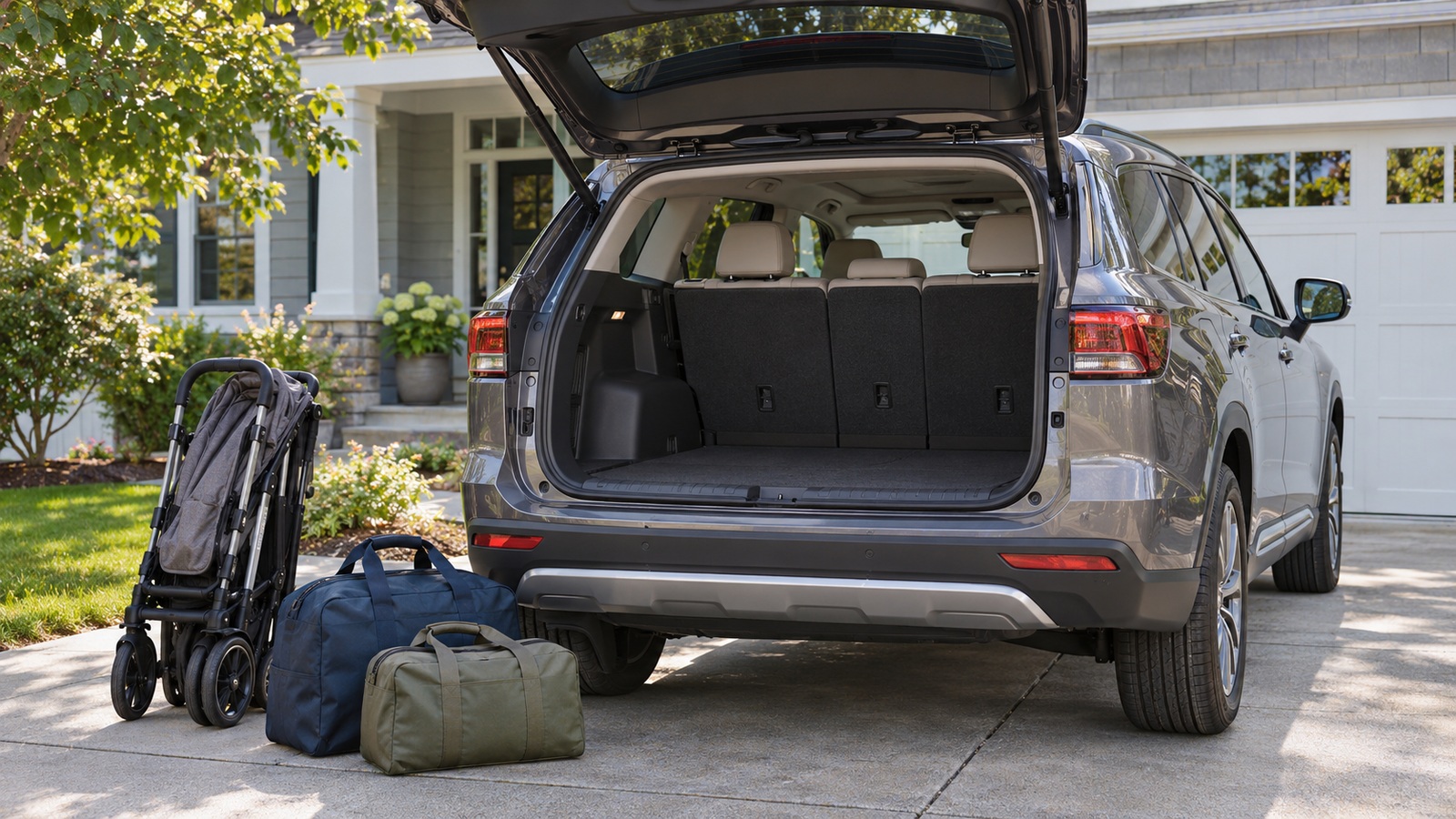
Measure the Trip You Actually Take
The compact SUV looks roomy until the rear-facing child seat, stroller, and weekend bags all need to travel at once. The midsize alternative appears to solve everything until it reaches your narrow garage. Choosing between them is less about buying the largest cabin you can afford than identifying which dimensions matter on the same journey. Passenger room, luggage space, carrying weight, and parking clearance must work together, with the seats you need left in use. Category labels can help build an initial shortlist, but they do not define a universal boundary or guarantee a useful amount of space. A careful fit test with your people and equipment will reveal more than a quick glance at a cargo-volume ranking.
Start With Occupied Seats, Not Folded Seats
Write down the number of people who travel together on a normal day and on your most important recurring longer trip. A household carrying two adults and one child faces a different space problem from one regularly carrying five adults. Include the person who usually sits behind the tallest front occupant, because that pairing can expose a shortage hidden by a generous brochure legroom figure. Set the driver’s seat correctly before anyone evaluates the space behind it. Moving it forward for the demonstration creates room that may not exist during actual use.
Ask passengers to stay seated long enough to judge foot placement, thigh support, shoulder contact, and visibility. Knees clearing the seatback is only one part of a comfortable fit. A high floor or low seat cushion can leave an adult sitting with raised knees even when the quoted legroom seems adequate. Center seats deserve their own assessment because cushion shape, floor humps, and the position of belt buckles can make them much less useful than the outboard positions. Check headroom with the actual roof equipment fitted, including any panoramic glass roof.
Compact SUVs often work well for modest passenger counts, while a midsize vehicle may offer more width or a more accommodating second row. However, two models carrying the same size label can allocate their dimensions differently. One may emphasize legroom, another a longer luggage floor, and another a stylish roofline that reduces head clearance. Keep a written record of the limiting dimension in each candidate. That makes it easier to distinguish a genuinely useful increase in space from a larger exterior wrapped around a similar seating problem.
Child Restraints Need Their Own Fit Test
Bring the specific child restraint you intend to use and consult both its instructions and the vehicle owner’s manual. A rear-facing installation can require space that ordinary seated-legroom measurements do not describe, and allowable contact with the front seat is not something to guess. Check the approved seating positions, anchor access, belt routing, and the front occupant’s resulting position. Do not assume that a midsize badge guarantees an easier or permitted installation. A careful installation assessment is more valuable than counting the anchors visible in a photograph.
If your household needs multiple restraints, test the complete arrangement together rather than fitting each one separately. Neighboring seats can interfere with installation, buckle access, or the ability of a larger child to fasten a belt properly. Also consider the daily job of lifting a child through the door opening without striking the roof or twisting awkwardly. For help, seek a qualified child passenger safety technician rather than improvising around the manufacturer’s restrictions. The appropriate vehicle is the one that supports correct use of every restraint your family needs at the same time.
Three Rows Do Not Always Mean Three Useful Rows
A midsize SUV may offer a third row, but the presence of extra seat belts does not tell you who will fit comfortably or how easily they can get there. Test the entry path with the second row positioned as it will actually be used, including any installed child restraints that must remain in place. Then sit in the last row and assess foot space, head clearance, belt fit, ventilation, and the ability to exit. Some occasional-use seats suit children or short journeys better than regular adult travel. Examine the luggage area with that row raised, because passenger capacity and cargo capacity have to coexist on the trip that matters. If all three rows will be occupied frequently, a minivan or a different vehicle class may deserve a comparison alongside the SUVs.
Read Cargo Figures as Screening Information
A published volume is helpful for identifying obvious differences, but it cannot show the shape of the usable space. A sloping hatch, rounded wheel housings, raised load floor, or narrow opening can prevent an object from fitting even when the total volume looks generous. Check how the manufacturer defines its figures and which seat positions or floor settings they use. Maximum volume behind the front seats answers a different problem from luggage space behind an occupied second or third row. Keep those conditions consistent when comparing listings.
Measure the cargo opening at its narrowest useful point, the floor depth behind occupied seats, and the available height where the tallest part of your load will sit. A stroller may need a long, flat footprint, while a rigid crate may be limited by the hatch’s upper corners. Small changes in shape can therefore be worth more than a modest increase in total cubic feet. Bring the object if practical and confirm that the hatch closes without pressing on it. Allow for securement and a useful view rather than packing every possible space to the roof.
Consider what the loading process requires after a tiring day. A lower sill may make groceries or a heavy mobility aid easier to lift, while a broad flat floor may let you slide equipment into position. Storage beneath the floor can help separate smaller belongings, but it may be occupied by a spare tire, charging equipment, or drivetrain components in another version. Check the actual vehicle rather than a display model with different equipment. Practical space includes access, organization, and the effort of using it repeatedly.
A Sliding Rear Bench Creates a Trade-Off
A second row that moves fore and aft can provide useful flexibility, especially when passenger sizes and loads vary. Nevertheless, the same inches cannot serve rear legroom and cargo depth simultaneously. Set the bench where your passengers can sit comfortably, then measure the luggage area in that position. A demonstration with the bench pushed fully forward may advertise a cargo advantage that disappears when adults climb aboard. Reclining seatbacks can create a similar conflict by occupying space above the cargo floor.
Try the adjustment controls and check whether the seat latches securely at the required position. Look at how the floor changes when the seats fold and whether the backrests create a slope, gap, or raised step. These details affect long objects and heavy equipment more than soft shopping bags. If you frequently alternate between people and cargo, assess how much lifting, walking around the vehicle, or removing equipment the conversion requires. Flexibility is valuable when you can use it conveniently in your real routine.
More Interior Volume Does Not Guarantee More Payload
Space and carrying capacity are separate limits. A cabin can physically accept several adults and dense luggage while leaving too little permitted payload for their combined weight, particularly after accessories or trailer tongue weight are included. Read the loading information for the actual vehicle and follow the manufacturer’s instructions for calculating the remaining allowance. Ford’s vehicle-loading guidance explicitly distinguishes volume limitations from weight limitations and includes passengers and cargo in the assessment. Do not use another trim’s online figure as a substitute for the relevant label. A larger SUV may have more carrying capacity, but options, powertrain, and design can change the result enough that it must be checked rather than assumed.
Park the Exterior Before Buying the Interior
A midsize vehicle’s extra cabin width can be welcome on a long drive and inconvenient every morning in a tight parking space. Measure the garage opening, the interior width at mirrors and doors, the available length, and any shelves or appliances that intrude. Leave room for people to get in and out and for the hatch to open as intended. Published body width may exclude mirrors, so identify exactly what each dimension includes. The amount of room left around the vehicle matters more than whether it technically fits between the walls.
On a test drive, assess the steering effort, turning circle, and the view when reversing into a normal space. Ask whether you can make a second attempt comfortably when another vehicle is waiting rather than judging the maneuver under ideal showroom conditions. Cameras help show boundaries, but image distortion, dirty lenses, and unseen obstacles still require attention. A compact model that carries your household comfortably may be preferable if its smaller footprint removes a daily source of difficulty. Conversely, cramped passengers should not be asked to tolerate unsuitable space merely to avoid measuring the larger alternative properly.
Price the Space You Will Use
Compare similarly equipped candidates rather than treating the cheapest compact and a highly specified midsize model as equivalent. Purchase price, financing terms, insurance, energy use, tire costs, and scheduled service all affect the price of moving up a size. A more expensive vehicle can also expose you to greater depreciation in dollars, although resale outcomes depend on the model and market. Obtain current quotes and use your expected ownership period. Avoid assuming that the category difference creates a fixed annual penalty that applies to every pair of vehicles.
Think carefully about an exceptional trip that happens only once or twice a year. Renting a larger vehicle, transporting an item separately, or changing luggage can sometimes cost less than carrying unused space through every commute. Those alternatives are not always convenient, especially when accessibility or repeated family travel is involved, but they deserve a realistic comparison. A roof box also introduces cost, loading effort, height restrictions, and manufacturer load limits. It is a specific equipment choice, not an unlimited extension of the vehicle’s capacity.
Allow for predictable changes in your household without buying around every imaginable possibility. A planned additional child restraint or a regular adult passenger is a stronger reason to reserve space than an undefined future need. Recheck the fit with the next likely arrangement if you can simulate it safely. The objective is enough useful capacity over the expected ownership period. An expensive step up that leaves the actual bottleneck unchanged is poor value, even if it provides a much larger maximum-volume figure.
Run One Combined Loading Rehearsal
Before deciding, place the front seats correctly, install the required restraints, seat the normal passengers, and load the important bags or equipment together. Confirm access to buckles and exits, check that the load can be secured, and verify that the relevant weight limits are satisfied. This combined rehearsal catches conflicts that isolated showroom demonstrations miss. Record which candidate passes comfortably and which requires a compromise you would have to repeat. Photographs and measurements can help you compare the finalists later without relying on the impression that one simply felt bigger.
Choose the compact SUV when it provides appropriate passenger fit, usable cargo room, and a manageable footprint for the tasks you repeat. Choose the midsize alternative when its additional space solves a clearly identified problem and its dimensions and operating costs remain practical. If neither works with every necessary seat occupied, widen the vehicle search instead of forcing the size labels to produce an answer. A good fit is a complete trip that works, from loading the driveway to parking at the destination.