The Structure Beneath the Shape
Two vehicles can have similar dimensions, engines, and ground clearance while carrying their loads in fundamentally different ways. One uses its body structure as an interconnected load-bearing assembly; another mounts its body on a separate frame. That choice influences how engineers arrange the cabin, control weight, tune the ride, and support demanding work. It also explains why a dented exterior panel is not necessarily structural damage and why an apparently tidy vehicle can still hide an expensive structural problem. For most drivers, an integrated unibody makes an excellent foundation for everyday transport, while a separate frame can suit particular hauling and off-road requirements. Understanding the engineering behind those tendencies is more useful than declaring either construction universally stronger, safer, or better.
Monocoque, Unibody, and the Language of Load Paths
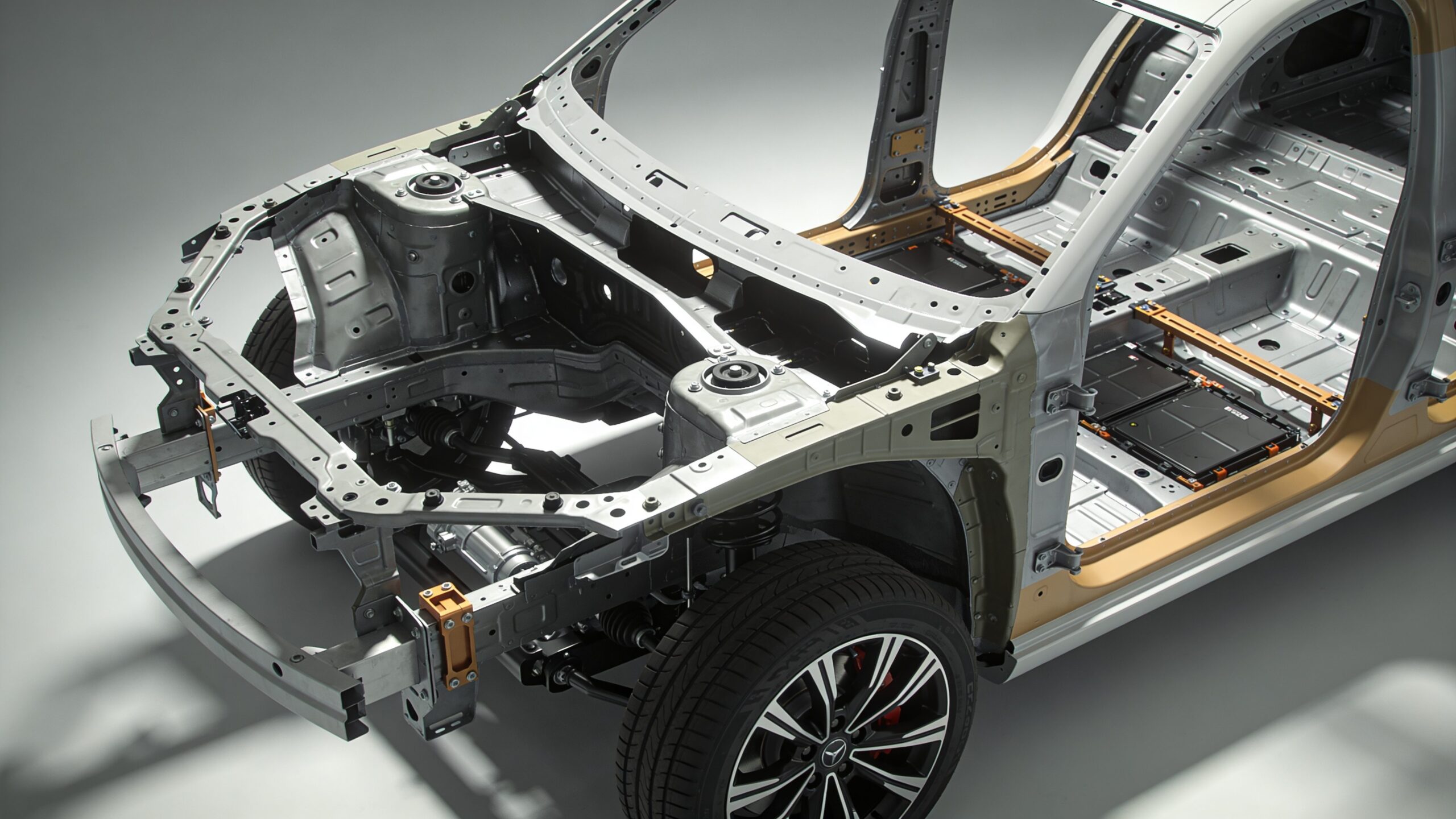
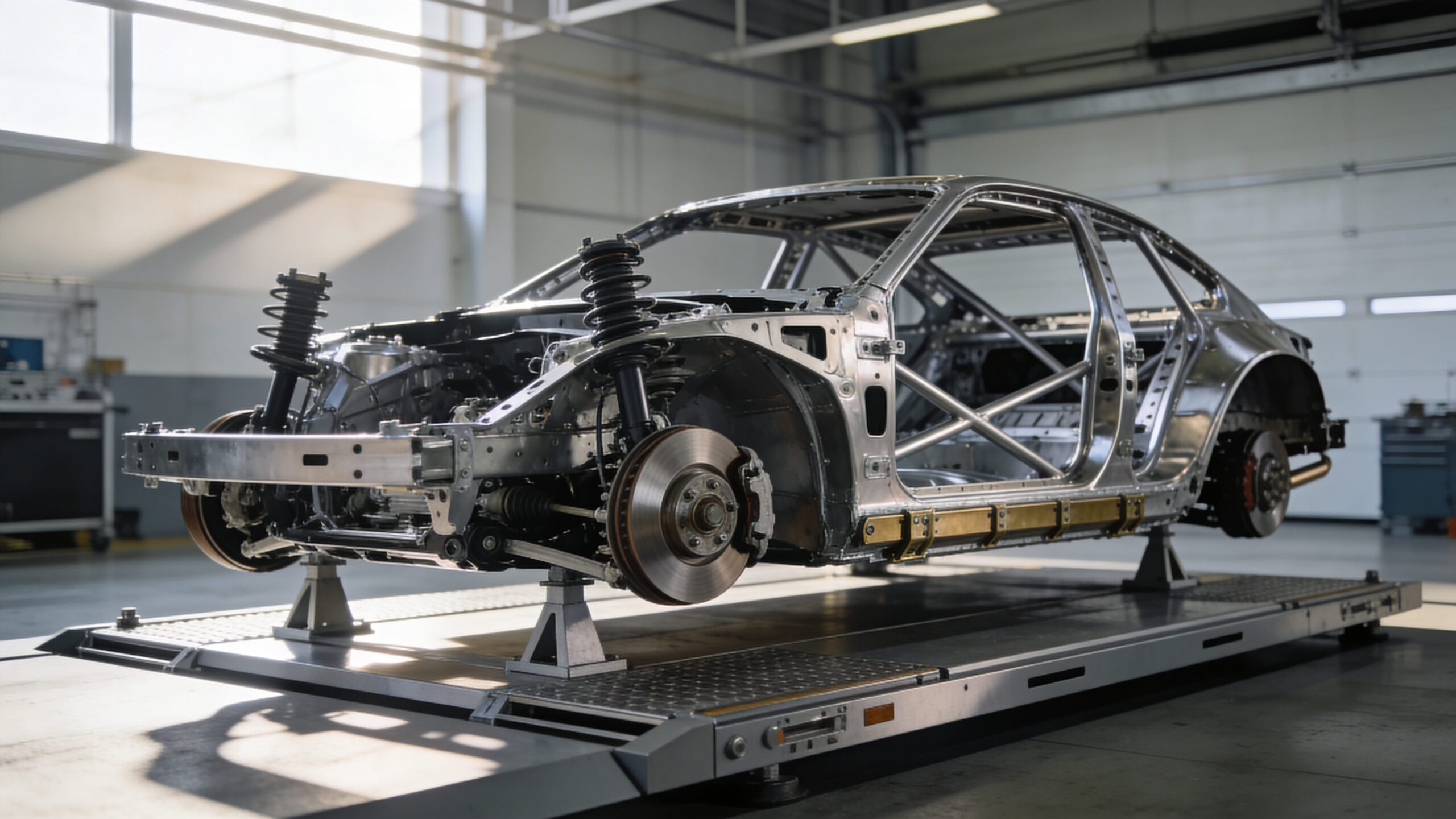
Strictly speaking, a monocoque carries loads through its structural skin. Modern passenger-car construction is usually more accurately described as unitized or unibody construction, with panels, closed sections, reinforcements, and joints working together. Everyday automotive discussions often use monocoque as shorthand for that integrated arrangement. The important distinction is that the body structure participates directly in carrying the vehicle’s loads, instead of merely sitting above a separate full-length frame. Calling it a shell should not suggest that it is thin wrapping around all the important machinery.
The floor, sills, pillars, roof rails, and crossmembers create interconnected paths for forces from the suspension, drivetrain, passengers, and road. A unibody may still have substantial front and rear subframes that support mechanical components. Those bolt-on assemblies do not turn the vehicle into a body-on-frame design, because they do not replace the body’s overall structural role. Likewise, the presence of steel rails under the floor is not enough to identify the construction. What matters is how the major assemblies share their loads.
How a Separate Frame Changes the Arrangement
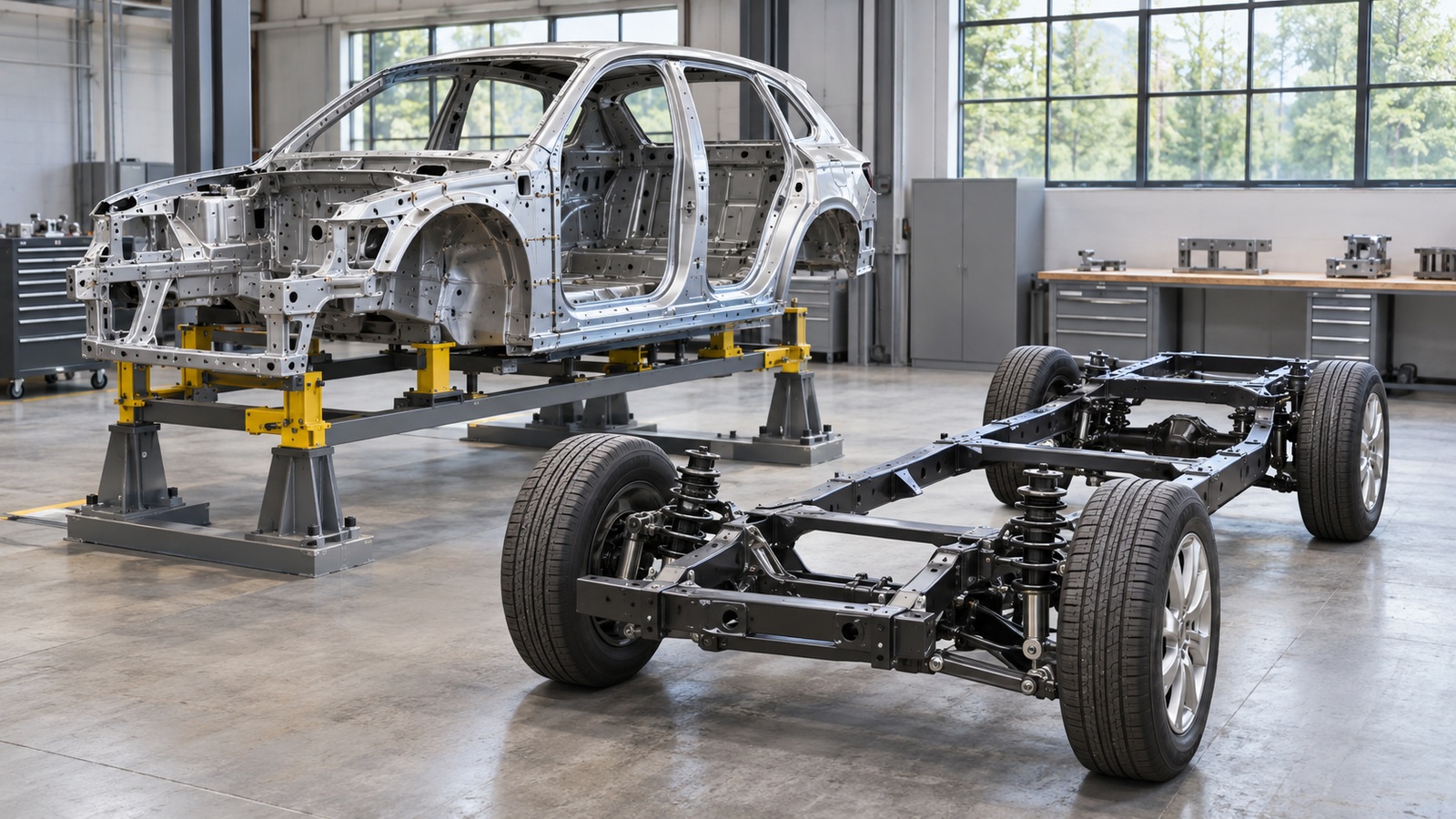
A body-on-frame vehicle starts with a distinct structural chassis, commonly using two longitudinal rails joined by crossmembers. The suspension and major mechanical assemblies attach to that chassis, while mounts connect the passenger body above it. The frame, body, mounting system, and mechanical components still interact; they are not independent machines that happen to travel together. However, separating their primary functions gives engineers and manufacturers a different set of packaging and durability choices.
This architecture can support families of pickups, utility vehicles, or commercial bodies that share major chassis elements. It also gives engineers a foundation for concentrated loads from equipment, trailers, or a cargo bed, provided the complete vehicle is rated for the work. A ladder-shaped outline alone does not establish capacity. Rail section, material, joints, crossmembers, suspension attachment points, and the rest of the vehicle must all be designed together.
The body mounts provide another tuning tool, helping manage vibration and the relationship between chassis movement and the passenger compartment. They also add components that can age, loosen, or transmit noise when worn. A used example with clunks or a shifting-body sensation therefore deserves a careful inspection rather than a broad assumption that such behavior is normal for a truck. Construction explains possibilities, but condition determines what a particular vehicle actually does.
Weight and Packaging Begin With the Whole Vehicle
Integrated construction lets engineers make useful structural contributions from parts already needed to enclose the cabin. That can reduce duplicated material and help deliver a relatively low floor, efficient interior space, and favorable mass for a given task. A separate frame generally occupies additional vertical space beneath the body, although axle design, drivetrain placement, battery packaging, and ground-clearance targets also shape the result. Neither arrangement guarantees a particular curb weight or seating height. An extensively equipped unibody SUV can weigh more than a simpler frame-based vehicle, and an electric platform adds its own structural and battery-protection requirements. Compare actual dimensions and weight rather than converting an architectural tendency into a promise about every model.
Stiffness Is a Design Target, Not a Badge
Structural stiffness describes resistance to deformation under load. Torsional stiffness concerns twisting, while bending stiffness concerns deflection along the structure; neither is identical to ultimate strength. A stiff foundation can help the suspension work consistently because the body or chassis moves less relative to its mounting points. Engineers can pursue that result with integrated construction, separate frames, reinforcements, adhesives, welds, or other joining methods. A material name or structural label cannot substitute for understanding the completed design.
Road feel also depends on springs, dampers, bushings, tires, seat construction, and the way noise enters the cabin. A well-developed frame-based SUV can feel composed and quiet, while a stiffly tuned unibody vehicle can feel busy over broken pavement. Listen for secondary shakes after a bump and compare the response on the same road at similar speeds. That observation tells you more about the finished vehicle than repeating a general claim that one construction always rides more comfortably.
Make the comparison concrete before a viewing. Suppose two candidates both fit the garage and carry the same ordinary luggage, but one feels unsettled over a familiar uneven junction. The useful follow-up is to establish tire specification, suspension condition and whether the sensation is normal for that model. Repeating that one has a frame does not distinguish a worn component from the finished vehicle’s intended behavior.
Similarly, a buyer seeking a quiet family vehicle should compare conversation comfort and how the cabin settles after ordinary road disturbances. Record the conditions so a second drive can examine the same concern. Architecture explains the available engineering choices; that repeatable observation helps determine whether the chosen implementation meets the household’s priorities.
Towing Loads Travel Through More Than the Frame
A separate frame is common in vehicles designed for substantial towing and hauling, but it does not create unlimited working capacity. Trailer forces pass through the hitch and its attachments into the vehicle structure, while tongue weight also consumes available carrying capacity. The powertrain, cooling system, brakes, axles, tires, and transmission must all support the intended operation. A unibody vehicle can tow safely within its specified limits, just as a frame-based vehicle can be overloaded by an unsuitable trailer.
Start with the exact vehicle’s owner’s manual and loading labels, including the installed equipment and required towing package. Ford’s load-carrying guidance, for example, explains that trailer tongue weight forms part of payload. Passengers, luggage, accessories, and other carried equipment also use that allowance. The maximum trailer figure in an advertisement should therefore never be treated as the only calculation that matters when a family and its belongings are aboard.
Consider a driver choosing between two SUVs for an occasional small utility trailer. If both are properly equipped and comfortably meet the loaded trailer and vehicle limits, the separate-frame label may add little practical benefit. A driver regularly carrying heavy equipment or towing within more demanding conditions may reasonably prioritize a platform developed for that job. The correct comparison starts with a defined load and a verified rating, then considers how the vehicle performs the rest of its duties.
Crash Protection Depends on Managed Deformation
A vehicle structure must do more than remain rigid. It needs to manage impact energy while preserving a survivable occupant compartment and supporting the operation of restraints. Integrated bodies and separate-frame vehicles can both incorporate carefully engineered deformation zones, reinforcements, and load paths. The Insurance Institute for Highway Safety’s shopping guidance emphasizes the complete protective system rather than a simple construction hierarchy. Seat belts, airbags, roof performance, and crash-avoidance equipment belong in the same evaluation.
Compare crash-test results for the specific model year, and understand the limits of comparing vehicles from different size classes. Greater mass affects collisions between vehicles, but buying a heavier vehicle is not an unlimited route to additional protection and can increase risk to others. Repair quality matters as well, because an incorrectly joined structural member may no longer respond as intended. An undamaged vehicle with strong model-specific evidence is a more defensible choice than one selected on the assumption that a visible frame automatically makes it safer.
Corrosion Can Undermine Either Architecture
Rust deserves attention wherever loads are carried, whether that means frame rails and mounting points or unibody sills, floors, suspension attachments, and internal reinforcements. Cosmetic surface oxidation and significant material loss are different findings, and fresh coating can obscure the distinction. Drainage, trapped debris, road salt, prior repairs, and storage conditions influence where deterioration appears. A clean outer panel does not reveal the condition inside a closed structural section. On a used vehicle from a corrosive environment, an independent inspection should assess the relevant load-bearing areas with proper access and methods. Never crawl beneath a vehicle supported only by its emergency jack to investigate a suspected problem.
Rough Ground Exposes the Complete Design
On rough ground, body construction works alongside clearance, tire grip, suspension movement, gearing, and protection. A separate frame can provide a useful foundation for repeated demanding work, but it does not supply those other capabilities by itself. Likewise, an integrated body does not exclude a vehicle from every unpaved route. Identify the actual obstacle and the complete vehicle specification: a maintained gravel approach asks much less than a deep rut that threatens an underbody component. Accessories add loads too, so their attachments and the manufacturer’s limits remain part of the decision.
Manufacturer descriptions show what the structural distinction looks like in real vehicles. Toyota identifies the 2026 RAV4 as a TNGA-K unibody, with reinforcement around body joints and suspension mounting areas. Its 2026 4Runner brochure instead identifies a TNGA-F boxed-steel ladder frame beneath the body. The comparison is about where loads travel, not a direct test of which vehicle survives a particular obstacle. For the RAV4, the surrounding body contributes to the structural system; for the 4Runner, the separate chassis is a primary foundation. When reading an underside photograph, therefore, identify the connections and the documented architecture rather than merely counting visible rails. This gives a buyer a construction clue without staging an informal twisting test.
Repairability Requires the Manufacturer’s Procedure
It is tempting to assume that a separate frame makes collision repair straightforward because the body can sometimes be removed or the chassis replaced. In practice, access, labor, parts availability, measuring requirements, and manufacturer restrictions can make that a major undertaking. Unibody repairs can also range from routine bolt-on panel work to highly specialized structural reconstruction. I-CAR’s vehicle-construction material distinguishes different structural arrangements, but repair decisions still require the instructions for the exact vehicle and component.
High-strength materials, heat-sensitive sections, bonded joints, corrosion protection, and prescribed replacement locations can limit what a technician may straighten, cut, weld, or reuse. Driver-assistance sensors may require inspection or calibration after relevant work, even when the visible damage appears modest. Ask a collision specialist to explain what was damaged, how it was measured, and which procedures governed the repair. A statement that a vehicle has been put back on a machine is less useful than a documented account of the actual structural work.
For an everyday commuter, choose a well-engineered vehicle that fits the required space, efficiency, comfort, and safety priorities; an integrated body will commonly meet that brief. For repeated heavy-duty work, evaluate vehicles developed and rated for those demands, including suitable frame-based options. In either case, inspect condition and verify model-specific capability before buying. The better structure is the one that serves the vehicle’s real job as part of a sound complete design, rather than the one with the most reassuring label.